
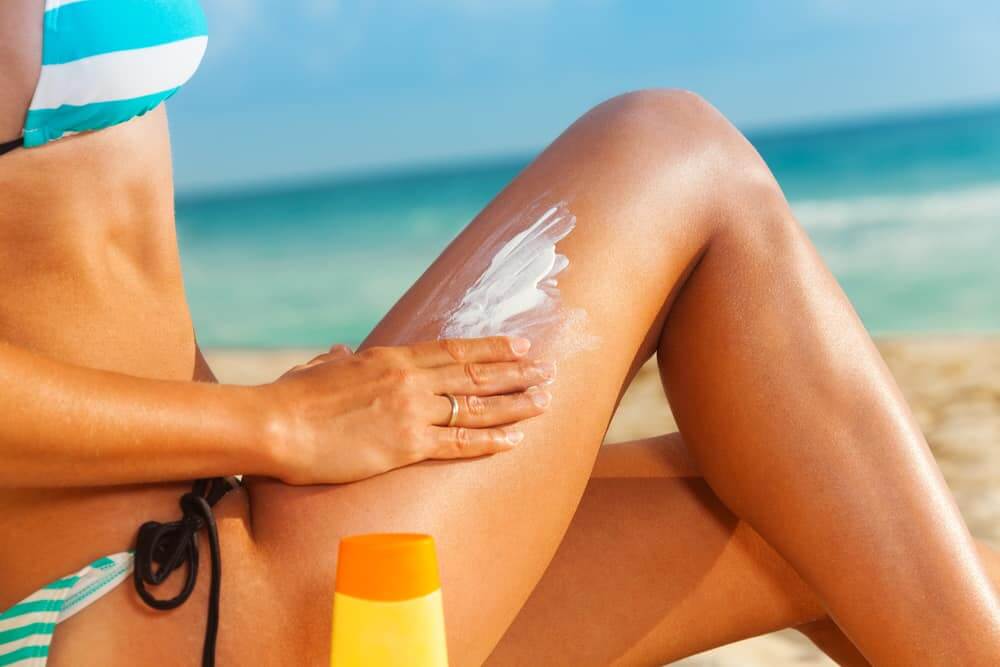
Wear Sunscreen!
If I could offer you one tip for the summer, sunscreen would be it!
The following information has been collected from the British Association of Dermatologists and the British skin foundation.
Let’s face it we all want to go on holiday and come back with an absolute beast of a tan, not only to look refreshed and healthy but also so people get jealous of the wonderful holiday we just had. However, it is imperative that we follow the guidelines on sun-protection.
The science behind a tan.
The dark pigment that gives the skin its natural colour is called melanin. Melanin is made in the skin by pigment cells called melanocytes. After our skin has been exposed to sunlight the melanocytes produce more melanin in attempt to absorb further UV radiation, and so the skin becomes darker. A tan is actually a sign that the skin has been damaged and is trying to protect itself.
Why should we be careful?
Nobody wants to spend the entire summer indoors, and indeed some sunshine, below sunburn level, can be good for us, helping the body to create vitamin D and giving many of us a feeling of general wellbeing as we enjoy outdoor summer activities.
However, all too often we over-do our sun exposure which can lead to a range of skin problems, the most serious of which include skin cancer. Other summertime skin problems include sunburn, photosensitive rashes and prickly heat. In addition, sun exposure can worsen already existing conditions.
While many people associate a tan with looking healthy, a tan is actually a sign that our skin has been harmed by UV radiation and is trying to defend itself against further damage. This kind of damage can in turn increase your risk of developing skin cancer: Sunburn (i.e. skin redness) and heavy tans can never be justified and are harmful.
More than 100,000 new cases of skin cancer are diagnosed annually in the UK, and while the disease can also occur on parts of the body not exposed to sunlight, extensive sun exposure is thought to be responsible for the vast majority of cases. In more than four out of five cases skin cancer is a preventable disease.
UVA and UVB
UV radiation from the sun is transmitted in three wavelengths – UVA, UVB and UVC. UVC does not penetrate the earth’s atmosphere, so we only really need to protect against UVA and UVB.
UV radiation in the form of UVA is associated with skin ageing. UVA affects the elastin in the skin and leads to wrinkles and sun-induced skin ageing (for example coarse wrinkles, leathery skin and brown pigmentation), as well as skin cancer. UVA can penetrate window glass and penetrates the skin more deeply than UVB. UVA protection in a sunscreen will help defend the skin against photo ageing and potentially skin cancer.
UVB is the form of UV radiation most responsible for sunburn and has strong links to different types of skin cancer. A sunscreen with a high SPF (sun protection factor) will help block UVB rays and prevent the skin from burning, and by extension damage that can cause skin cancer.
How do sunscreens work?
Organic filters absorb harmful UV radiation and convert and give this energy back out as infrared. These are sometimes known as ‘absorbers’, or ‘chemical’ sunscreens. Note that organic filters does not mean ‘organic’ in the environmental sense.
Inorganic filters (also known as ‘physical’, ‘natural’, ‘reflective’, ‘zinc’) contain titanium dioxide or zinc oxide, which reflect UV radiation away from the skin.
It can be helpful to think of organic filters as sponges, mopping up the UV radiation, and inorganic filters as mirrors, bouncing UV straight back off the skin.
What is SPF?
Sunscreens in the UK are labelled with an ‘SPF’. This stands for ‘sun protection factor’, although the SPF is more accurately the sun burn protection factor, as it primarily shows the level of protection against UVB, not the protection against UVA. SPFs are rated on a scale of 2-50+ based on the level of protection they offer, with ratings between 2 to 14 forming the least protected end of the spectrum and ratings of 50+ offering the strongest forms of UVB protection. We recommend a sunscreen with an SPF of 30 as a satisfactory form of sun protection in addition to protective shade and clothing.
UVA star system
When you currently buy sunscreen containing UVA protection in the UK you may notice a UVA star rating on the packaging. The stars range from 0 to 5 and indicate the percentage of UVA radiation absorbed by the sunscreen in comparison to UVB, in other words the ratio between the level of protection afforded by the UVA protection and the UVB protection.
Be aware that if you choose a low SPF it may still have a high level of stars, not because it is providing lots of UVA protection, but because the ratio between the UVA and UVB protection is about the same.
That’s why it’s important to choose a high SPF as well as a high UVA protection (e.g. a high number of stars). Sunscreens that offer both UVA and UVB protection are sometimes called ‘broad spectrum’. A sunscreen with an SPF of 30 and a UVA rating of 4 or 5 stars is generally considered as a good standard of sun protection in addition to shade and clothing.
New Sunscreen Labelling
The new EU Recommendation means that you will notice changes on the labelling of some manufacturers’ sunscreens. As well as the SPF number, the SPFs are categorised as providing low to very high protection, to make the SPF guide easier to understand. The below table illustrates this:
| New Label | SPF |
| Low protection | 6 to 14 (i.e. SPF 6 and 10) |
| Medium protection | 15 to 29 (i.e. SPF 15, 20 and 25) |
| High protection | 30 to 50 (i.e. SPF 30 and 50) |
| Very high protection | 50 + (i.e. SPF 50+) |
According to the EU Recommendation, the UVA protection for each sunscreen should be at least a third of the labelled SPF. A product that achieves this requirement will be labelled with a UVA logo, the letters “UVA” printed in a circle
Skin Types
Naturally occurring biological agents in the skin absorb a proportion of UV irradiation, melanin being one of these. Melanin is a pigment molecule in the skin and is packaged slightly differently in people of different ethnic backgrounds.
Dermatologists generally divide skin types into six categories, from phototype 1 – fair skin that burns very easily in the sun and does not tan, to phototype 6, which is darker black skin that does not burn easily.
People with a darker complexion have more natural sun protection, and fair-skinned individuals are more susceptible to sun burn, skin cancer and photodamage.
The key character difference between black and white skin is that of melanin packaging and processing. The type of melanin of all skin colours is eumelanin except for those with red hair and freckles, who have phaeomelanin, which is less well able to cope with UV irradiation.
If you tan very easily, as with black or Asian skin (e.g. types 5 and 6) you need less ultraviolet damage to initiate the tanning process. You do not need a sunscreen to stop skin cancer and skin ageing to the same extent as a fair skinned person, but sunscreen will still be needed during intense or prolonged exposure.
If you are of Mediterranean type skin (e.g. Type 4), you also tan easily, but you will need more ultraviolet to tan than lighter skins. You can still suffer from UV damage and although you are less likely to develop melanoma than skin types 1 to 3, your skin will age with sun exposure.
If you are very fair and cannot tan at all (e.g. Type 1), you will not tan with or without a sunscreen, but you will damage your skin badly if exposed without protection. You need to take particular care to regularly apply lots of high SPF sunscreen (i.e. 30 or above) with high UVA protection too. It is also important to remember to wear proectedtive clothing, such as long t-shirts, and spend time in the shade during the hottest parts of the day.
The Top Sun Safety Tips
Protect the skin with clothing, including a hat, t-shirt and sunglasses
Spend time in the shade between 11am and 3pm when it’s sunny
Use a ‘high protection’ sunscreen of at least SPF 30 which also has high UVA protection, and make sure you apply it generously and frequently when in the sun.
Keep babies and young children out of direct sunlight
The British Association of Dermatologists recommends that you tell your doctor about any changes to a mole – if your GP is concerned about your skin, make sure you see a Consultant Dermatologist (on the GMC register of specialists), the most expert person to diagnose a skin cancer. Your GP can refer you via the NHS.